
Drug Pricing Indexes: Wholesale Acquisition Cost (WAC)
Cultivating clarity in the complex world of pharmacy benefits is our mission. In this post, we take a closer look at Wholesale Acquisition Cost (WAC), one of the core manufacturer list price benchmarks used throughout drug pricing and contracting. Whether you work in the industry or are simply trying to better understand how drug pricing functions, WAC is a foundational concept. Below, we outline what WAC is, how it is used in practice, and the nuances that shape its impact across the drug value chain.
DRUG PRICING INDEXES
2/17/20265 min read

In this Episode:
The Basics
Breaking down
the AcronymsParallel Concepts
How it Works
In Practice
When it's Used
Pros and Cons
The Fine Print
WAC Increases
WAC Decreases
Dual NDC Strategies
The Basics of WAC
Practical Applications of WAC
The Fine Print of WAC
Conclusion
While WAC may appear to be a simple list price, it plays a central and nuanced role in the pharmacy benefits ecosystem. As a manufacturer-set benchmark, it anchors rebate contracts, influences financial modeling, and indirectly affects member cost exposure. Its meaning is shaped less by the number itself and more by the contracts built around it.
At The Coy Pharmer, our goal is to make these complex dynamics more transparent and accessible. Stay tuned as we continue to examine drug pricing indexes, including deeper comparisons between WAC, AWP, NADAC, and more.
Impacts of WAC Increases
Wholesale Acquisition Cost is not static. Manufacturers may increase WAC over time, sometimes on an annual or twice-per-year cadence, and sometimes in response to market dynamics, competitive positioning, or policy pressure. These changes can influence rebate structures, plan sponsor projections, and broader scrutiny of drug pricing trends.
Because WAC and Average Wholesale Price (AWP) generally move in parallel, shifts in WAC can have broad downstream effects. Those systemwide impacts are explored more fully in the AWP discussion. From a WAC-specific perspective, the most direct effect is typically seen in rebate calculations, since many rebate agreements are structured as a percentage of WAC.
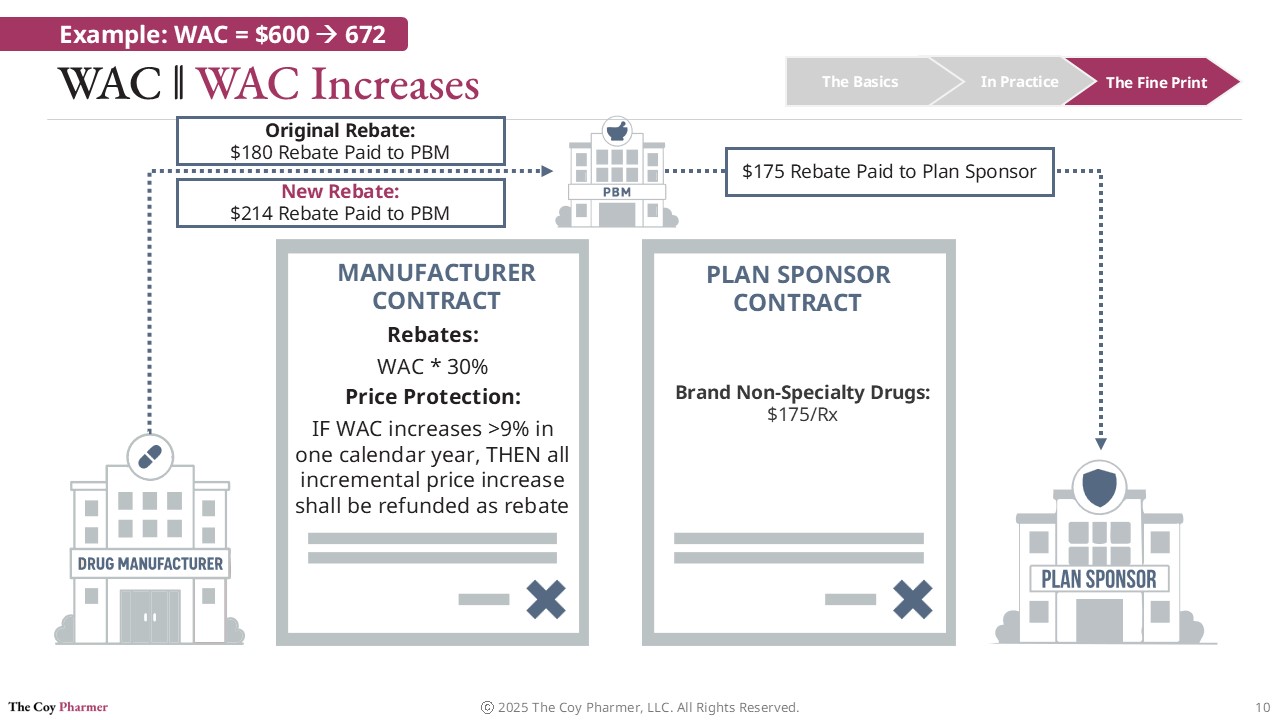
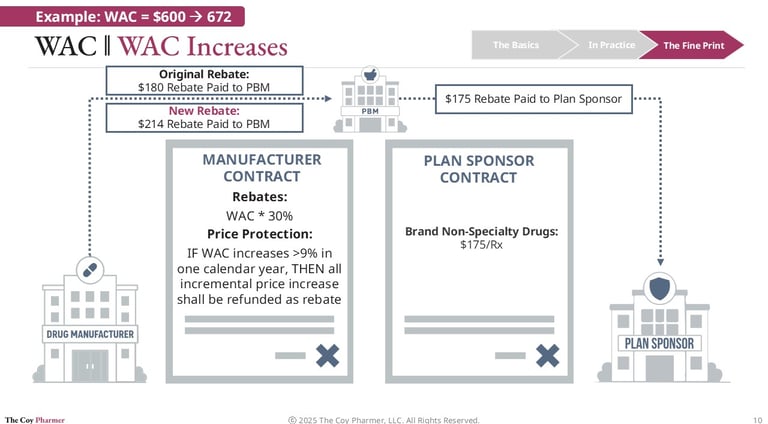
For example, if a drug’s WAC increases from 600 dollars to 672 dollars in a single year, the rebate amount payable to the PBM may also increase. This can occur in two ways. First, a WAC-based rebate formula automatically yields a higher dollar rebate when the underlying list price rises. Second, price protection provisions may be triggered. These provisions are designed to shield PBMs and plan sponsors from unexpected in-year WAC increases and can generate additional rebate liability for the manufacturer.
Impacts of WAC Decreases
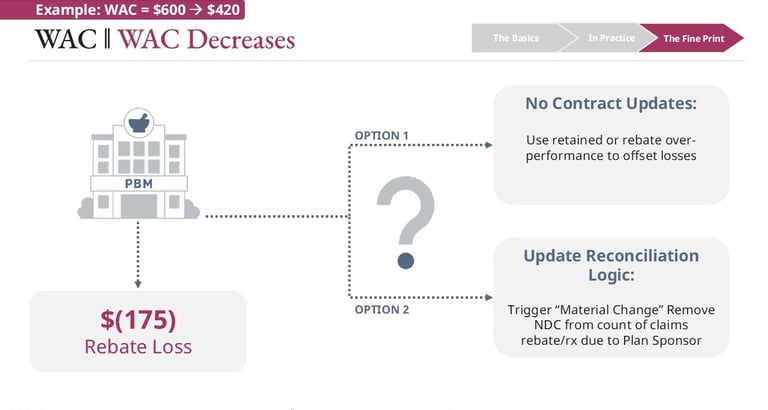
In recent years, some manufacturers have made sudden and substantial reductions to the WAC of select National Drug Codes (NDCs). When this occurs, the manufacturer is often choosing to compress the gross-to-net bubble. Instead of maintaining a higher list price paired with large back-end rebates, the strategy shifts toward a lower list price with reduced or eliminated rebate offerings.
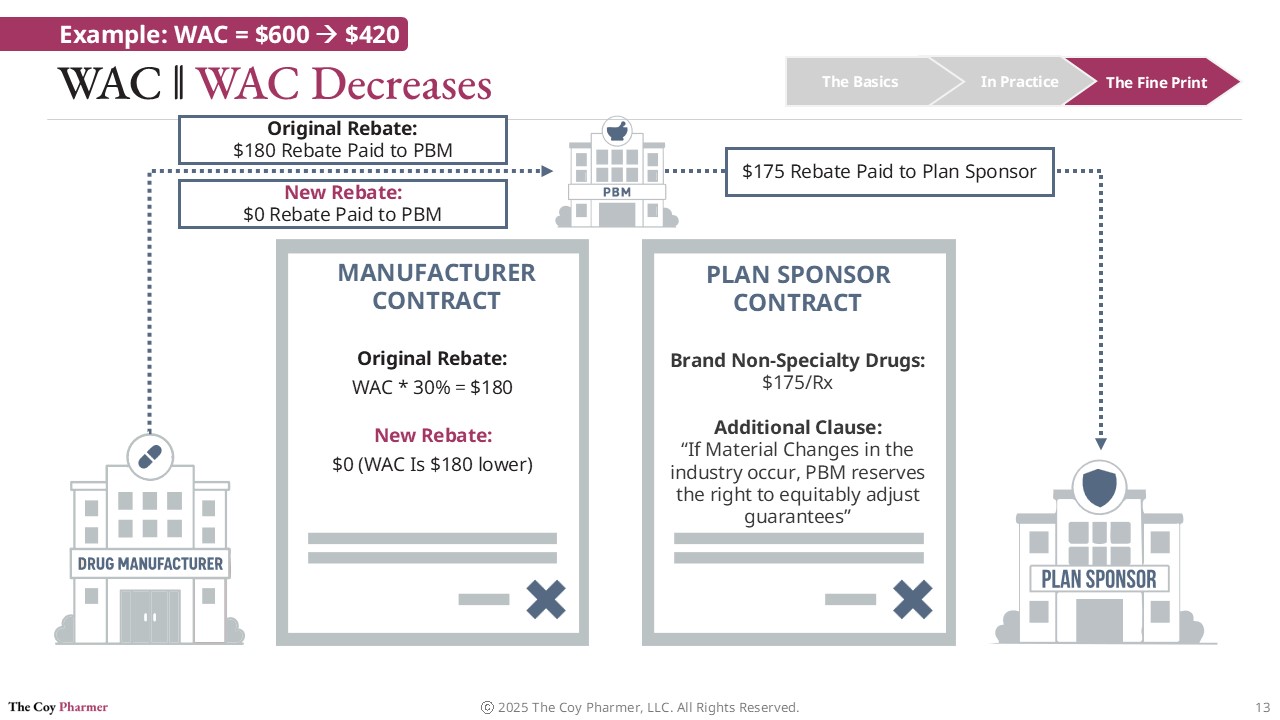
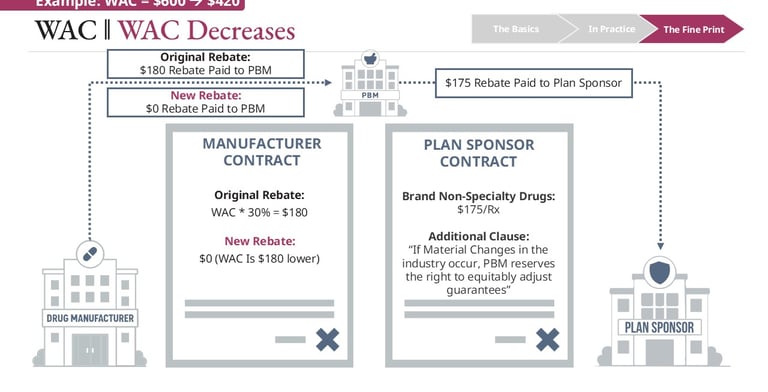
These changes can create operational and financial challenges for PBMs. When WAC drops and rebate structures are removed or reduced, PBMs may no longer be able to invoice the rebate amounts originally anticipated in their contracts with manufacturers. This disrupts expected financial flows that were built into pricing guarantees and modeling assumptions for rebate amounts due to plan sponsors.
As a result, PBMs are often faced with difficult choices. They may absorb the lost revenue, which can pressure margins, or they may seek to update contract terms or reconciliation approaches with plan sponsors. Adjusting plan sponsor terms, however, can introduce friction, particularly if pricing guarantees, rebate expectations, or financial projections were built around the prior higher-WAC, high-rebate structure.
Dual-NDC Strategies
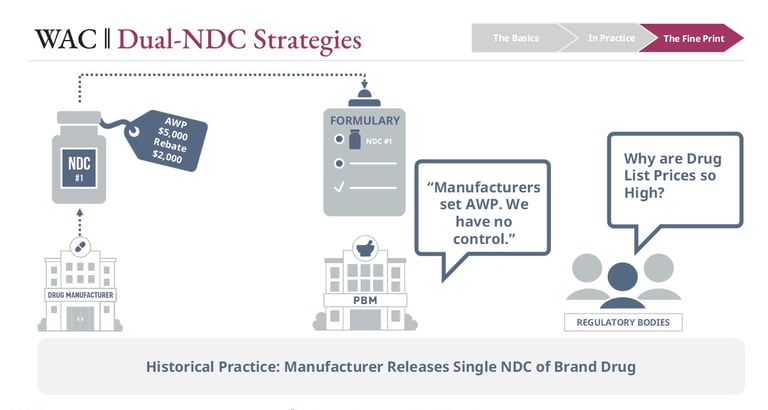
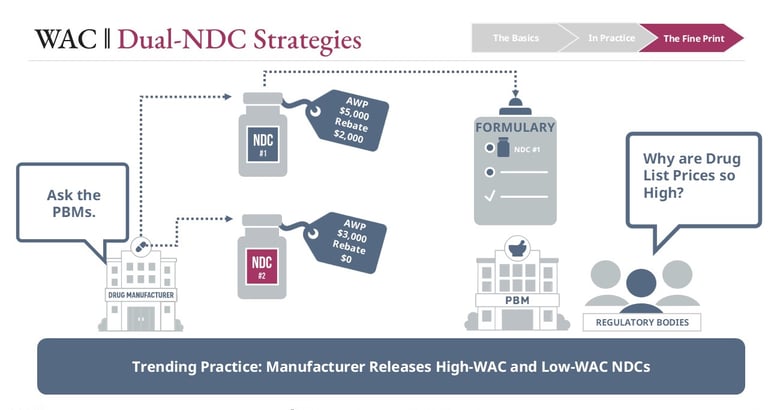
Manufacturers may also use product lifecycle strategies that involve WAC adjustments. In some cases, new National Drug Codes (NDCs) are introduced for the same or similar products with different WAC levels. These approaches can influence formulary placement, contracting dynamics, and competitive positioning within a therapeutic class.
Regulatory bodies, including the Federal Trade Commission, have increased scrutiny on manufacturer list prices in recent years. In response to this pressure, some manufacturers began releasing multiple WAC levels for a single product. This allows them to offer a lower-list-price version with reduced rebates alongside a higher-WAC version that maintains traditional rebate structures.
PBM responses to these strategies can vary. Some major PBMs have continued to prefer higher-WAC versions, due to the margin structure and competitive implications tied to existing rebate-driven models. Others may shift toward lower-WAC alternatives depending on client demand and contract design. This remains an area of ongoing change as market and regulatory forces continue to evolve.
The WAC index is closely related to Average Wholesale Price (AWP). In many cases, AWP is set at approximately 1.2 times WAC, though this relationship is not uniform across all products and exceptions do exist. While AWP is often used as a pharmacy reimbursement reference and in Pharmacy Benefit Manager (PBM) contracts with plan sponsors, WAC more commonly underpins rebate contracts and manufacturer pricing strategies.
WAC also influences member cost exposure in certain benefit designs, due to its correlation with AWP. While most rebates are not reflected at the point of sale, list prices such as WAC can indirectly affect member out-of-pocket costs when coinsurance or deductibles are tied to a percentage of the drug’s price. In this way, WAC increases can contribute to higher upfront costs for members, even when net plan costs are offset through rebates later. For more details on this phenomenon, visit our blog on AWP.
How these higher rebate amounts flow through the system depends on contract terms. In some arrangements, increased rebates are largely passed through to the plan sponsor. In others, plan sponsor guarantees may not adjust in proportion to rising rebate yield, allowing PBMs to retain a portion of the incremental value.
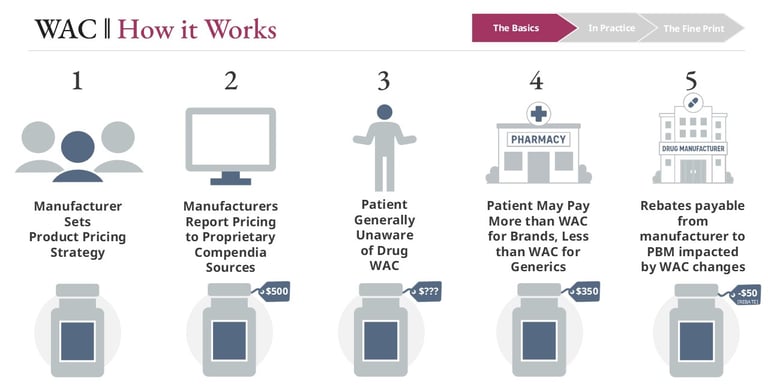
Wholesale Acquisition Cost (WAC) is a manufacturer-published list price for prescription drugs. It is often described as the price wholesalers pay to manufacturers, before discounts, rebates, or other price concessions. While WAC is closer to real transaction pricing than some other benchmarks, it still does not represent the final net cost paid by pharmacies, plan sponsors, or patients. Instead, it serves as a standardized reference point that anchors contracting, rebates, and financial modeling.
WAC values are established by drug manufacturers and reported to commercial drug pricing compendia such as First Databank® and Medi-Span®. Importantly, WAC is not derived from observed net market transactions and does not reflect confidential rebates, performance guarantees, or other post-sale price adjustments. As a result, WAC should be understood as a starting point in the pricing conversation, not the final price in the system.
WAC functions differently for brand and generic drugs. For brand drugs, WAC often more closely aligns to pharmacy acquisition costs. For generics, however, acquisition costs frequently diverge from WAC significantly. This can be due to competitive sourcing, wholesaler arrangements, and market volatility.
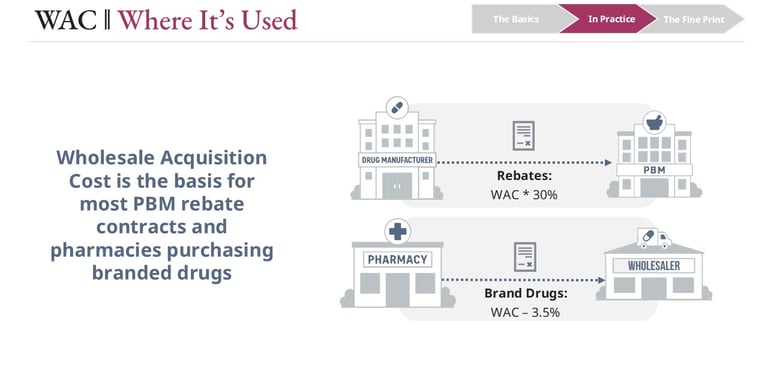
Wholesale Acquisition Cost is deeply embedded in manufacturer, PBM, and plan sponsor contracting. Many rebate agreements between manufacturers and PBMs are structured as a percentage of WAC, making WAC the baseline from which rebate dollars are calculated. This structure plays a central role in determining the net cost of brand drugs for plan sponsors.
Pharmacies often purchase brand medications at WAC minus a negotiated discount through their wholesaler or group purchasing organization. This creates a predictable framework for acquisition, even though downstream reimbursement may be tied to other benchmarks such as AWP or Maximum Allowable Cost (MAC). The relationship between WAC-based purchasing and AWP-based reimbursement is a key driver of margin dynamics within the pharmacy channel.
Because of its role in rebate calculations, WAC is also central to financial modeling and procurement decisions. Pharmacy benefits consultants, PBMs, and plan sponsors frequently rely on WAC-based assumptions when forecasting drug spend, evaluating formulary strategies, and comparing manufacturer rebate offerings. Small changes in WAC can materially influence projected gross costs, rebate dollars, and net plan spend.
Links
hello@thecoypharmer.com
© 2025 The Coy Pharmer, LLC. All Rights Reserved.